Monday, November 16, 2009

Paranormal Activity

http://www.youtube.com/watch?v=F_UxLEqd074 - Here's the official trailer

I would first like to point out that if you haven't seen this movie and are planning to, then don't read this blog post because I will be discussing the story line and the ending. I don't want to ruin it for anyone.

I admit that although Paranormal Activity scared me to death, it was the best scary movie I've ever seen. Paranormal Activity was filmed as a fake documentary. The premise of the film was that this undergrad student Katie, who currently lives with her boyfriend Micah, has been followed by this demonic entity since she was a child. Strange occurrences took place when she was little like her house burned down and she would always see a dark shadow at the edge of her bed. The characters and the audience never see the demon because it's invisible, which is important to keep in mind when analyzing the film. In the beginning, weird things started to take place in Katie and Micah's house. They began to hear noises and footsteps at night, and objects in the house would be in random places. To investigate, Micah documented their experience with a camera and begins to antagonize this demonic figure. After a series of extremely disturbing events including Katie getting dragged out of bed by the demon and pulled across the hallway, the demon eventually gets what it wants, which is Katie. At the end she is possessed by the demon and kills Micah.

I think this movie affected me so much because of various reasons. To start, the film is very psychological. It's not gory, a part from the last scene, which I think makes it scarier because in the movie the danger being observed by the audience is really directed at the characters' (and the audience's) mental state. I also think that since the movie is set up as a documentary it adds a slight touch of reality and the audience can connect to that. The characters live normal lives in the film and it's disturbing for an audience to see that an average person's life can be invaded and ruined by this force that the audience and characters can't even see. That really brings about the terrifying question: How can we fight something that we can't see? I think this deeply relates to Parker's mention that horror films boom during war time. The United States is fighting terrorism and it's hard to stop things like suicide bombers. Threats to society seem to be all over the place and could even be hidden in plain sight. I think that is one aspect of the film that is truly horrific, because we can't fight or face what we can't see. It also touches on the idea of torture - not physical torture but mental torture. The fear of a collapsed economy and an enemy that we can't always point out really takes a tool on people's minds.

Another reason why this movie is so scary, is that it doesn't quite follow all of the cliches we see in horror flicks today. When watching a film in the genre, I can usually point out the archetypal characters and figure out what's going to happen within the first 15 minutes. With this movie, I couldn't. Even though it's structured like the Blair Witch Project because it's filmed as a documentary and the audience can't see the threat, it doesn't have some of the same aspects that would normally make an audience member feel disconnected from the film. There's no music during the entire movie and there are no credits at the end. The audience is left in a haunting silence to soak in what just happened. Movies like One Missed Call and Dead Silence were just terrible because they were formatted to fit the horror genre. I've seen all of that before and I even laugh at it sometimes, because eventually it just becomes so overplayed. I think we don't see that many films like Paranormal Activity, so it stands out.

However, the film is not without it's archetypal themes. One theme that is illustrated in the film is masculinity. During one scene Micah is holding a very long, sharp knife while defending his masculinity and claiming that he is going to fix everything. That's quite an obvious phallic symbol. Micah's masculine presence becomes a problem for the demon, who after possessing Katie, seeks to kill him. At the end, the camera is situated in their bedroom and the possessed Katie goes downstairs and starts to scream. Micah then runs downstairs, screams, and then there's silence. Although the audience doesn't see Micah's murder, they later see his body and it appears that he has been stabbed several times. The audience comes to assume that Micah was stabbed by a knife - a symbol that he used as an extension of his masculinity. It seems like this is the typical way for the director to kill or "castrate" Micah and prove that his masculinity is meaningless.

This movie honestly scared me because I did feel like I was watching a documentary. I had to keep telling myself that it wasn't real. The fact that this antagonist in the film was invisible made it even worse, because it was not something that could be defeated and there was no resolution at the end. Overall, the movie was very effective in completing its goal of freaking people out.

Parker was also right in saying that many successful horror movies are made with a miniscule budget, but eventually make a lot of money. Paranormal Activity was first released in the Screamfest Film Festival in 2007 and was made on a budget of $15,000. When the film was released this year in about 200 theaters, it made approximately $9.1 million. The film also surpassed the Blair Witch Project's box office record. IMDB also stated that Paramount Pictures has announced that there may be a sequel - so we'll see if the next film follows the same format or tries something new.

Tuesday, November 10, 2009

The future of news media


I was watching the Daily Show with Jon Stewart tonight, and he pointed out some Fox News video clip that was unbelievable to watch. Fox had a clip of a recent rally that opposed the Health Care Reform bill. Although there were only about 10,000 people there, according to the Washington Post, Fox put the number at somewhere between 20,000-45,000 people. The clip showed footage from two different rallies - the one against the health care bill and the 912 rally. The 912 rally had much more people there and Steward insinuated that they used the footage to make it seem like there were more people than the Washington Post reported. Is this a simple mistake or something that was done on purpose?

The television news programs seem to be getting more and more biased. This makes me question the future of news media in the country. Discerning fact from fiction is becoming extremely hard since every station seems to be pulling for some political party or another. I've found it hard to make an independent decision based purely on facts, because every form of news media seems to say something different.

Other forms of news media seem to be in trouble. Newspapers are going online in order to survive, because at this rate, print journalism isn't going to be as popular as it once was and the amount of newspapers are declining every month. Even news radio may be at risk. Stations like NPR could be in trouble. Many people seem to be going online to listen to the radio, since internet radio is getting more and more popular. People are using 'Radio Bookmarks' and iPhone users can even tune in with certain downloadable apps. The news media is changing a lot and it seems that journalistic ethics are changing as well.

Filtering Reality Article


The Filtering Reality article really surprised me. Augmenting reality seems a little scary. Facial recognition and blocking certain people that sponsor Sarah Palin or are anti-gay marriage seems extreme. Blocking reality with pop-ups and advertisements is not something I would want to do. The AR system just seeks to shield people from how the world really is, while forcing their virtual advertisements on people's phones. I agree with Cascio that this type of system will promote centrism. The world and communication are about sharing views and values, not blocking them. I personally don't want the physical world to be blocked out, I want to see it how it really is. I don't want to live in some virtual world that's going to feed me ads anyway. I want to see someone's shirt because someone's style expresses who they are; I don't want to see some pop-up ad placed over a person's unique piece of clothing. The idea that the "wrong" people can be blocked by this system is preposterous. Just because someone is a Republican or a Democrat doesn't make them the "wrong" person to be around. To be a united and tolerant society, blocking people out like they don't exist will only make things worse. Cascio had it right: "The harder answer, but ultimately the correct one, would be to strengthen our society’s ability to tolerate diverse viewpoints—to encourage not muddy centrism, but a basic ability to hear out, and to see, fellow citizens with a measure of respect."

Monday, November 9, 2009

Fallow's NY Times Article

I was re-reading Fallows' NY Times article and began to think about Starr and what technologies today have been used by politicians to shape media. Starr discussed how certain political choices have changed the media. I think to this day the media does respond to the social and political times, but I also think that politicians are now starting to be more friendly with certain mediums and want to benefit from them. The newspaper industry has of course been used by politicians in this country since the American Revolution. Mainstream media today includes a lot more than newspapers; it involves TV, Facebook, Twitter and the like. We've all seen commercials for politicians exploiting one political party and praising another. Remember those Hilary Clinton 3 am phone call ads and John Kerry's Vietnam War controversy? But these days politicians and the government use media in a different way. They know the media can hurt them, so they reach out to their audience through media instead of trying to restrict the media as the British government did. For example, Barack Obama mobilized his followers and gained popularity because of his outreach on Facebook and Twitter. Other politicians also have Twitter and Facebook pages, so people can follow what they're doing and feel more connected.

However, the media is still regulated by the government even though we have free speech. The FCC censors and regulates what we watch on TV and movies. With the internet though, there is a lot less regulation going on. Just like the telegraph, the telephone, and the radio, the internet is being run by big private companies like Google, Yahoo, and Facebook. There is pressure on the internet to give customers what they want, but this is just pure business unlike the TV companies that must give in to what the FCC wants. The internet allows anyone to say anything they like; it's a true outlet of freedom of speech. Perhaps this stemmed from the dislike of FCC regulations and censorship. On the internet we see a lot of different opinions that millions of people want to share, and I think that this might have come about from the changing political and social times. For instance, since the Afghanistan and Iraq War people have been trying to get their voices heard to either spread support or dislike of the war.

I also would like to point out that a little while after the Iraq War started, we did begin to see changes in the media. Some things that I noticed was that the news became more biased and shows and networks began to take sides. For example, CNN is more liberal and Fox News, well, is not. Even though there was not a very big anti-war movement in America, there were anti-war productions such as Fahrenheit 911, Jarhead, and Stoploss. The media seems to be showing war as the cruel and terrifying thing that it really is, instead of glorifying and supporting it like some parts of the media were during World War II. I think that Starr makes some very good points and shows proper examples of how politics have changed the media, and it has been interesting to look at the media today and how it has responded to political choices. Even when I watch The Daily Show or Colbert Report, they are responding to what's going on in the world. After reading Fallows' article however, I will make sure to pay more attention to how the media reacts to political decisions.

Sunday, November 8, 2009

Winston


Yesterday, I was explaining our midterm to my family and told them about the man in Dunkin Donuts. My aunt proceeded to tell me that when they were my age, they got along just fine without cell phones and that I probably would've been more inclined to have a conversation with a stranger sitting by me, instead of texting a friend. My parents and my aunt and uncle all agreed cell phones and Facebook have revolutionized how we communicate with each other and that they've caused the art of conversation to die. Now, there may be some truth to this. I've talked to many teachers that have found that kids are typing "ur" instead of "your" in their papers, so maybe it is affecting students' grammar. While we were talking about this, I began to think about Winston. Cell phones and Facebook aren't revolutionary technologies; they're evolutionary. The cell phone was modified from the telephone and Facebook stemmed from the internet, AOL instant messaging, and Myspace. They are evolutionary products that came from inventions that have value in society. So, I don't completely agree with my family because these technologies are just helping us evolve. Yes, my generation communicates a bit differently than theirs, but we still know how to have a conversation with someone face-to-face.

Cell phones, in particular, have become social necessities. People need to get in touch with others very quickly from all over the world because our society has been globalized. Social circumstances have changed and cell phones have stemmed from those changes and many scientific advances. Cell phones and Facebook are user friendly and fun; they are accelerators and have become important in every day life. At the Honors Conference, the speaker for The Outdoor Classroom, asked us to take out our cell phones. At first, I thought she was going to ask us to turn them off, but she didn't. We were actually asked to do a survey by texting our answers to a certain number. Our answers automatically appeared on the projection screen that was attached to the speaker's computer. I thought this was pretty cool and a very evolutionary way to learn. I think that technology today is helping us evolve the way in which we communicate and hasn't revolutionized or destroyed the way we talk to one another.

Saturday, November 7, 2009

Being Everywhere at Once


Last night, I went to see Paranormal Activity with two friends that teach at my old high school. My one friend had done an England exchange program in high school and said that for a long time she lost touch with the girl she had stayed with. They used to be good friends and she felt sad that they were no longer in touch. Recently though, her British pal found her on Facebook and they were able to catch up. She said that she absolutely love Facebook because there is no other technology or media that one can use to find and connect with people. The two of them are now able to be in each other's lives, even though they're in two different countries.

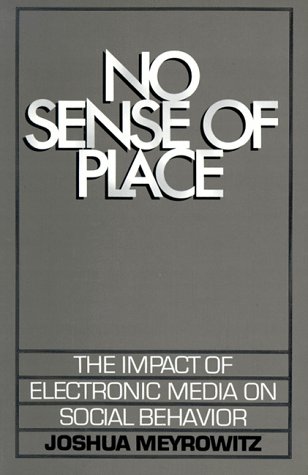
Facebook has really changed the social and physical places that Meyrowitz discusses. He writes, "When we communicate through telephone, radio, television, or computer, where we are physically no longer determines where and who we are socially." This is extremely true of Facebook. I can talk to people all over the world and have a social life, while sitting on my couch. Physical place doesn't matter that much in this case and socially I can be whoever I want. Something that I find interesting with social and physical place is that online we can be everywhere. Our "identity" can be right on the screen at one of our friend's houses. Our lives are basically accessible from any place that has wifi. For instance, a guy I graduated from high school with joined the army and was deployed to Iraq. Facebook was the fastest and easiest way he had to connect with his friends and family who were halfway across the world. He also used it to upload pictures and videos of himself and other soldiers doing patrols; he even posted several videos of him with other soldiers in a convoy going through the streets of Iraq. Even though none of us were there with him, we saw some of the things he was seeing and going through. I think this is a pretty powerful connection. It is so different seeing war through a soldier's eyes than seeing it on the news. Although he was in the Middle East, he was still able to have a social life outside of his physical place. Our experiences are no longer limited to where we are physically, because online we're everywhere.

Distracted


Yesterday at the Honors Conference, Hailey and I attended the "Environment of the Performing Arts" lecture. At first I didn't think that the performing arts would come to be connected with our media midterm, but I was very wrong. The first speaker, a 25-year-old woman, explained to us that our generation is not the biggest audience for performances. Most of those attending traditional shows as the Tilles Center are older. She connected this information to the fact that our generation is so used to media and technology being every where. We've become so distracted by all of the different technologies and information that are thrown at us every day, that it has become hard for us to sit down and stay focused on one thing. She told us that we're exposed to about 1,200 advertisements a day. While I know that we see advertisements all the time, I was surprised at the number. The media is really thrown into our faces wherever we go. Advertisers put entertaining reminders of their products and shows in newspapers, on internet sites, buses, radio stations, taxis, posters, movies, and of course television. No wonder a large portion of my generation doesn't want to sit down and focus on art.

I personally love the arts, but I have found myself to be impatient and distracted at times. Sometimes on a stage we don't see big neon signs, celebrities, and the bells and whistles that advertisers use to wow us. To a certain extent, I think we've gotten used to seeing information packaged in a fast and flashy way. This problem is not just affecting the arts; it's also affecting education. Many teachers these days are using technology in the classroom to get their students' attention. I was talking to an Italian teacher I know, and she was telling me how in the past couple of years, she has noticed that her students are becoming increasingly distracted. Whether or not the media and advertisers are the only causes of a distracted generation, I cannot say; however, it does seem to be a factor.

Another speaker discussed how years ago, it seemed that radio and television were going to be the death of theatre. Why go out to see a play when you can either see a show on TV or hear one on the radio? Radio and television were really accelerating technologies that took off and the arts community thought it was going to take a hit. One of the speakers even connected this to her every day life. She explained that she sometimes works from home and at times, there really isn't a need to leave. She has the internet, TV, and her cell phone. What more does she really need? Why should someone go see a show or an art exhibit when there are several forms of entertainment at the tips of your fingers? How do we adapt art to fit our new lifestyle? How should we react to this explosion of media and the problem of distraction? These are some interesting questions that our society needs to consider.

Friday, November 6, 2009

Midterm: completely attached


Last week, while waiting for my mom at Dunkin Donuts, I had an eye-opening experience. I sat down at a table and immediately took out my cell phone to check the time and to text some friends while I was alone (mostly because I had nothing else to do but wait). An old man came up to me, tapped me on the shoulder, pointed to my cell and said, "What would you do without that thing? You'd probably be lost!" To be a good sport I laughed and agreed. This made me look at cell phones through his eyes. His generation probably views mine as being technology obsessed and dependent on the technological luxuries we can afford. I suppose we seem a bit spoiled, but to a certain extent cell phones have become a necessity in several ways. People use their cells for professional, social, and emergency purposes. Personally, I've used it in all three ways, so my cell phone has really become an important tool in my daily life.

This reminded me of McLuhan's idea that technology or media becomes an extension of ourselves. He stated that human beings now wear "its brain outside its skull and its nerves outside its hide" in the form of media, which extends our senses. I have very much come to feel that my cell phone is a part of me. It's just another mode in which I can communicate with people and gather information. McLuhan seemed to think that technology creates the social and media environment, and I think that the cell phone has made these two environments portable. Even though I was technically alone in Dunkin Donuts, I didn't feel lonely because I had my friends in the palm of my hand. Everyone was one text or dial away. It's obvious that these days people have the need to constantly be connected, and the older gentleman that spoke to me doesn't feel that impulse because cell phones weren't around when he was my age. Therefore, he never cultivated the social need for it.

I honestly freak out if I don't have my cell phone. I get paranoid because if something bad happens, I won't have a way to get help. For instance, over the summer my car kept on dying. It died on me several times in the middle of a busy street and I was lucky enough to have my cell, otherwise I would've been in a lot of trouble. Also, if I didn't have my cell, I think I would feel very left out and lonely. The man was right; I would be lost without it.

Sunday, November 1, 2009

Critical Analysis: Pandora

I'll admit that before this assignment,
I had never heard of Pandora before. I would just mindlessly listen to z100 or any other radio station just to fill up my time. But now, I'm convinced that Pandora is the better solution. I created an account and entered a couple of musicians like Johnny Flynn, The Black Keys, and Iron & W
ine. Not only did Pandora play great songs from those artists, but the
site also played songs from different bands that I've never heard of. I actually liked almost all of the musicians that Pandora played, such as R.L. Burnside. To me, this is so much better than listening to the same ten
songs on z100 all day. I get to listen
to what I want and explore new music. I think Pandora really puts power back into the listene
rs hands because we have the choice to like or dislike something. There's a system that dictates what to play, but I still have the option to skip something I don't like and move on to something else.

Many radio stations today seem to play the
same singles all the time. I've
bounced between three radio stations that were all playing the same Lady Gaga song before and I'm honestly tired of it. With Pandora, that doesn't happen because the site has a large va
riety of artists. Also, there aren't as many commercials on Pandora. I can listen to about 5 or 6 songs and I only have to suffer through 30 seconds of one com
mercial, instead of listening to several minutes of advertising.

The NY Times article about Pandora's Music Genome Project was very interesting. It has definitely helped me understand how Pandora is calculating my musical tastes. It's a lot more scientific than looking at the top selling albums of the day and playing singles from those albums. It's also a lot more personalized and I've really come to appreciate that. Pandora uses real musicologists to break down the songs in order to determine what the listener prefers. For example, I didn't even put one of my favorite artists (Ben Harper) on the list, and Pandora played him. I thought it was interesting how the president of CBS Interactive Music Group said, “Music is an inherently social experience." He said this because it's all about how we share music and how we tell stories. On Pandora, the site shares music with me and in turn I can share it with other people and connect with fans of the bands that I like. Maybe Pandora is more than an internet radio site. It seems to be taking radio in a completely new direction of personalization and social connection.